
Advantages of Using String PCS in the Energy Storage Systems
With the proliferation of energy storage systems, the architecture of power conversion systems (PCS) that convert battery energy into grid-compatible AC energy has become increasingly important. String PCS-based architectures (similar to string inverters in photovoltaic systems) offer significant advantages over centralized PCS solutions in terms of operational efficiency, flexibility, and cost.
1. Higher System Availability and Reliability
Centralized PCS manages the entire battery block through a single large unit. This means that if the unit fails, the entire storage system is taken offline.
In a String PCS architecture:
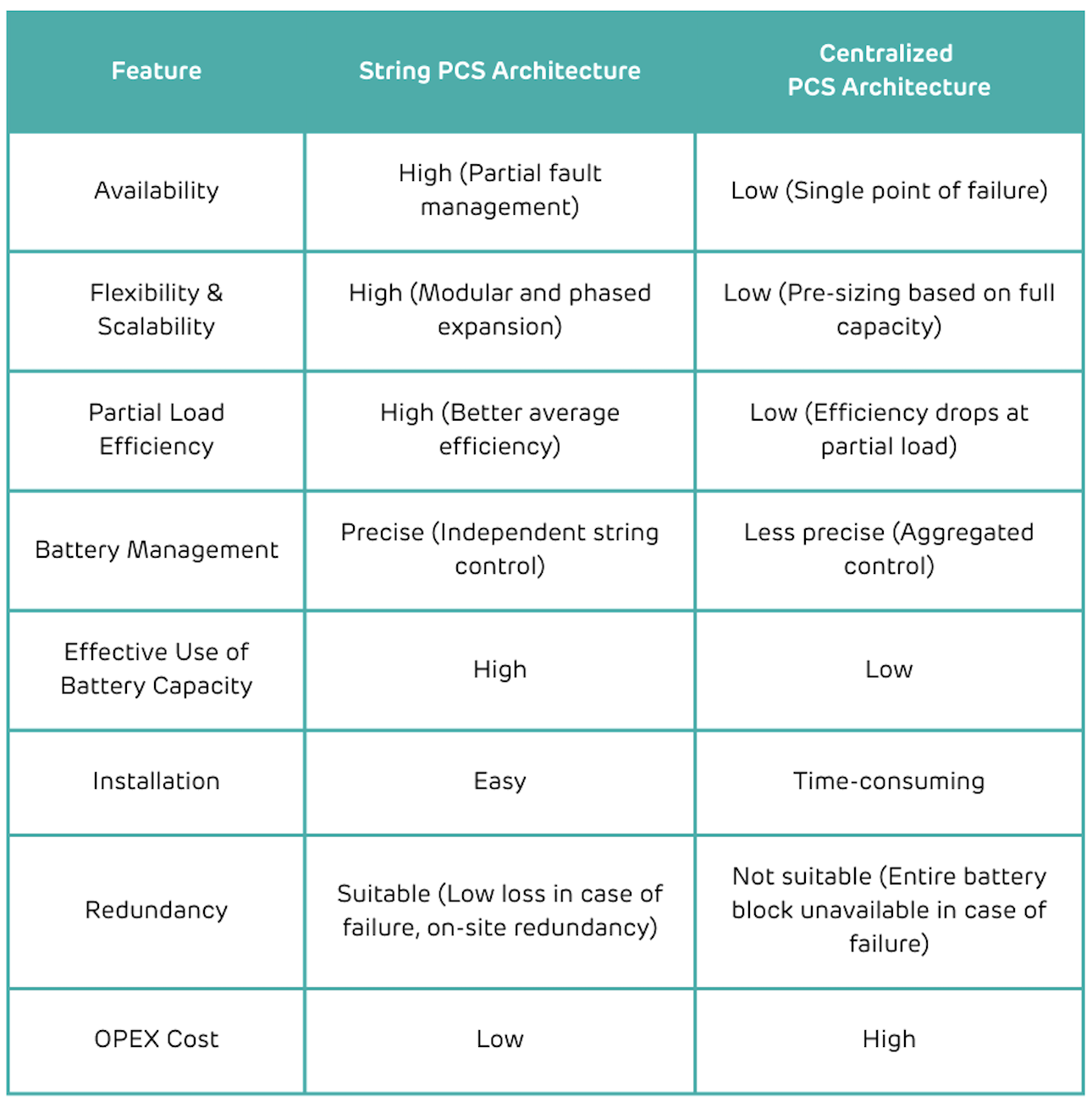
Partial Failure Management: The system consists of smaller, modular units, typically ranging from 50 kW to 250 kW. If a String PCS fails, only a small portion of the system is affected. The remaining units continue to operate, significantly increasing overall system availability.
Faster Mean Time to Repair (MTTR): String PCS units are typically lighter and easier to replace modules. In the event of a failure, replacing the entire unit is much faster than repairing a large and complex central PCS on-site.
2. High Flexibility and Modular Scalability
String PCS solutions provide superior flexibility from the project's inception and for future expansions:
Design Flexibility: Thanks to their modular design, String PCSs can be easily adapted to different battery configurations, voltage levels, and different site layouts (e.g., sloped terrain or confined spaces).
Phased Expansion: The project's capacity can be increased in phases as needed. New battery cabinets and corresponding String PCSs can be added to the system without having to shut down the existing system. Central PCSs must typically be sized according to the maximum capacity determined during the initial installation.
3. Advanced Precision in Battery Management
Precise Charge/Discharge Control: String PCSs can independently charge and discharge the battery strings or cabinets connected to them. This reduces the impact of incompatibilities caused by voltage or temperature differences between battery packs.
Long Battery Life: More balanced management of battery units prevents individual battery cells from being overloaded or undercharged. This helps extend the overall service life of the battery.
4. Optimized System Efficiency
Partial Load Efficiency: Energy storage systems do not operate at full capacity at all times of the day. String PCSs can shut down (sleep mode) the remaining units by operating only the necessary number of units during times of low power demand. This translates to higher average efficiency under partial load conditions compared to central PCS. Centralized PCS efficiency can drop significantly when operating at a small percentage of their capacity. (The difference will be understood after a detailed examination of the efficiency values in low power conditions compared to their nominal power in the efficiency curves.)
Huawei’s String PCS solutions further strengthen these advantages by combining modular architecture with advanced digital control capabilities. Their design enables independent optimization of each battery string, improving system-level efficiency and ensuring more precise charge-discharge management under varying operating conditions.
In addition, Huawei’s integrated monitoring and fault isolation features enhance system availability by quickly identifying and isolating issues at the string level, minimizing downtime and operational risk.
This approach aligns closely with the core benefits of String PCS architectures, higher reliability, scalability, and optimized performance, making it particularly suitable for large-scale and future-proof energy storage deployments.
5. Simplified Installation
Installation Ease: String PCS units are smaller and lighter. This reduces the need to transport heavy equipment on-site and speeds up the installation process. They can typically be easily integrated into standard containers or outdoor cabinets.
6. Low OPEX
Low Operating Costs (OPEX): Centralized PCSs usually require expensive and complex cooling systems. String PCSs, on the other hand, can operate with natural convection or simple fan-based cooling systems, which reduces operating costs (especially electricity consumption).
Conclusion and Evaluation
In large-scale energy storage projects, the choice between centralized and String PCS systems is more than a technical detail; it is a strategic decision that affects reliability, revenue, and long-term sustainability.
String PCS offers concrete advantages in terms of reliability, fault tolerance, maintenance flexibility, long-term efficiency, and scalability. By minimizing the impact of individual failures, it ensures that the system continues to generate value even when things go wrong. It provides a significantly more advantageous solution than centralized PCS, especially in projects with challenging field conditions or where future capacity increases are expected. For operators and investors, this translates to higher availability, lower risk, and a future-proof investment.


