

6 Reasons to Have Energy Management System for Your Business

Why You Should Have Energy Efficiency Improvements
Electricity bills are a big cost for business owners. The good news is that improving efficiency can help reduce the cost of electricity bills and bring significant benefits to business people. According to IEA’s 2018 energy efficiency report, energy efficiency improvements since 2000 have prevented a 12% increase in energy use in 2017 IEA.
From installing LED lighting to upgrading heating and cooling systems, businesses can implement a range of strategies to lower their energy footprint and at the same time improve property value and reduce operating costs. Other solutions include but are not limited to building sealing and insulation, power factor correction, and improving the quality of supply. This does not mean that you need to change some of your expensive assets. However, before acting, you should understand your energy profile to know which energy reduction strategies will best suit your business needs. This can be provided by energy management systems.
Here are some reasons why you should have an energy management system for your business.
Know Your Energy Needs
Here’s an energy management strategy that will help you understand your consumption patterns; i.e., when you’re using your energy most intensely and which kinds of processes or equipment are contributing to this. You can pinpoint your energy waste with advanced data analytics.
Australia’s energy consumption rose by 1.1 per cent in 2016–17 to reach 6,146 peta-joules, according to Australian Energy Update 2018, Department of the Environment and Energy, Environment. Some actions need to be taken to increase efficiency and reduce consumption.
Hence, reduction in your electricity consumption will transform costs to savings and better your consumption patterns. In addition, if your business has operations in different locations, energy management systems will provide benchmark across your offices/ branches/depots/ shops, etc.
Improve Your Power Factor To Reduce Your Electricity Bill
An energy management system will also show your active and reactive power data which you will need to understand your power factor.
Power factor represents the relationship between real and apparent power.
Real power is used in your system, but apparent power is a combination of real and reactive power. Reactive power is a circulating component between the network and some type loads (motors, converters, etc.), and it is not converted directly to a work. However, if your tariff has charges either directly on reactive energy or on peak demand, you will still be paying for not only real power but also reactive power. The higher the reactive power the higher you pay for apparent power and peak demand.
Power factor is between 0 and 1, and a higher value means higher efficiency.
As a result, taking control of your power factor will reduce your electricity bill significantly. Power factor correction equipment, which supplies circulating reactive power instead of the network, will be a cost-effective measurement. In addition, your equipment’s lifespan will increase because you will be regulating your voltage level, which is directly related to the equipment lifespan.
There are several types of power factor correction equipment like capacitors, static compensators, etc. which are used mainly for reactive power compensation and voltage regulation. Capacitors are generally a good fit in industries because of relatively cheaper installation costs compared to other measures. However, capacitors should be designed and sized properly to avoid the amplification of harmonics (resonance phenomena) generated by disturbing loads such as arc furnaces, welding machines or rectifiers. To avoid this, either harmonic filters or static compensators can be used. The good news is that business can claim up to $41/kVAr by installing Power Factor Correction (PFC) equipment Energex.
Track Your Energy KPIs To Reduce Your Operational Cost
Building energy performance can also be improved by effective energy management systems. Different business segments have different performance criteria; for example, consumption/m2, kWh/occupant rate for hotels, etc.
It is obvious that suitable KPIs should be in place to develop efficient energy-saving strategies, and the importance of benchmarking KPIs across your operational units for monitoring the performance and driving improvement potentials with the KPI is also crucial for process improvements.
As a result, the successful application of a KPI depends on its continuous measurability and accurate data in a timely manner. Energy management system helps to track these KPIs across your operational units with related metrics. Hence, you as a business owner can find effective solutions to track energy saving opportunities.
The energy management system also enables to set a target value like targeted electricity consumption/month and targeted cost/month so that deviations will be easily tracked and identified. In addition, an energy management system provides a comparison between the previous and the current situation for energy efficiency assessments and helps to systematically develop KPIs.
Reduce Your Electricity Demand Charge
A demand charge is a part of electricity bill where a daily charge is determined by the highest power demand (load) observed during a certain time frame during the day in a specified period. It is usually the maximum demand at a 15- or 30-min interval and calculated on kVA or kW. Your electricity bill will mostly be influenced by the highest demand for used energy at this particular point in time.
One of the main reasons kVA demand charges are being introduced is to encourage customers to improve their power factor. A poor power factor places higher demands on the electricity network. There are benefits for customers and our network when the power factor is improved according to Ergon.
As you can see below invoice, the network demand charge in kVA contributes has the biggest portion of the total electricity bill.
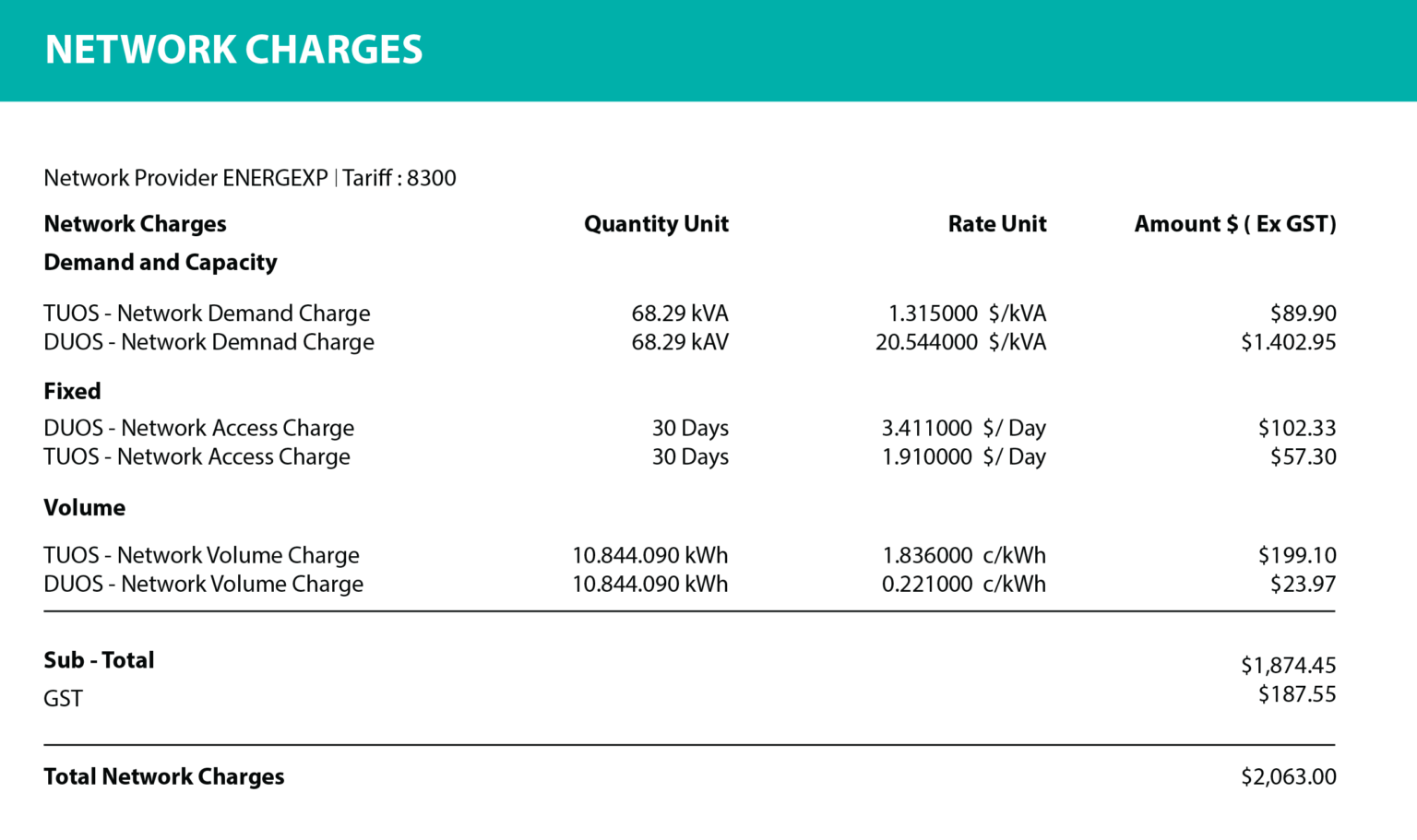
Figure 1: Electricity Bill
- To pay less to demand charge, there are some strategies that could help, such as:
- Be aware of your consumption and identify when your consumption is the highest
- Then, change your high load periods accordingly
- Identify the most electricity consuming equipment and take action
- If you decided to buy new equipment, be careful about their energy ratings
To take these actions, accurate data and analytics are needed from EMS, which will show you which equipment consume more or will show your consumption trends. In addition, EMS will also track your demand charge and will send a notification if you are close to out of limit.
Being Aware Of Your Solar System Health
Owning a solar system will give you a big chance to reduce your electricity cost and demand charges, but it is very important to know if your solar system is working as expected.
Australia achieved a record year in 2017 with more than 1.1 GW of new solar capacity installed, even though fewer systems were installed overall compared to some previous years according to CEC. Considering the reduction in ROI now would be a good time to think about having your own power generation system.
The energy management system will send production in real time, so if there is any failure in your system, you will get a notification and you will not wait for your next electricity bill to take action.
The energy management system will also give expected and actual production values to track your system performance for previous and current periods.
Your HVAC System Is Under Control.
HVAC is one of the biggest energy consuming equipment and needs to work efficiently.
Heating Ventilation and Air Conditioning (HVAC) is generally responsible for a significant proportion of total building energy consumption. A typical system accounts for approximately 40% of total building consumption and 70% of base building (i.e., landlord) consumption according to Department of the Environment and Energy as can be seen in Figure 2. Energy.
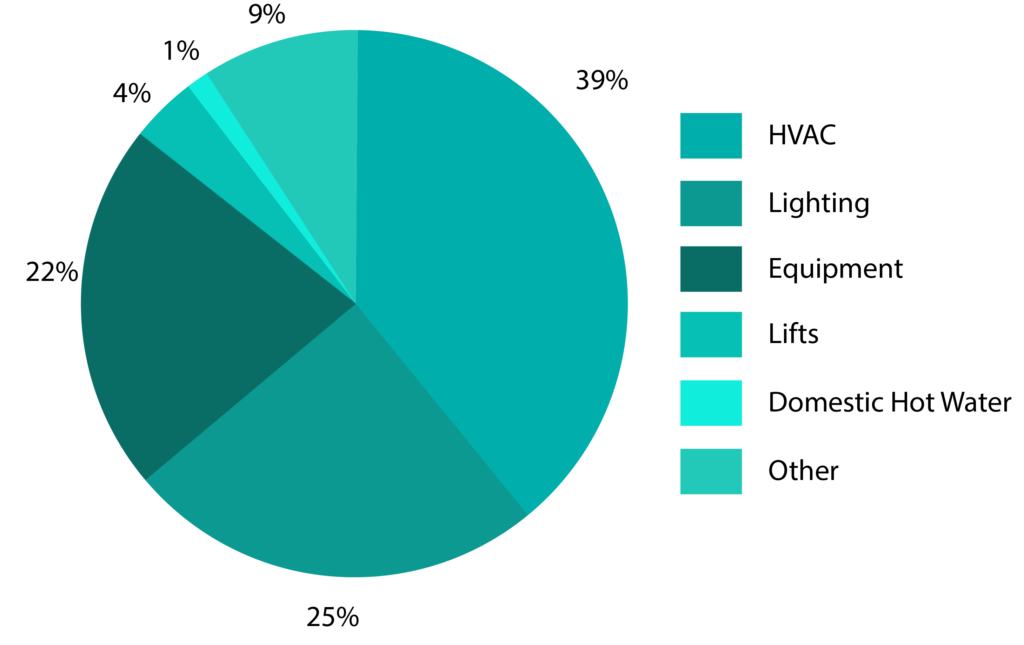
Figure 2: Energy Consumption In Buildings
- Load disaggregation option of energy management system will provide more insight about your HVAC and other energy consumed equipment load details.Reduction in energy use of HVAC can be achieved, and some of the strategies are:
- Change or clean your HVAC filters
- Identify optimum set points
- Identify energy waste times
If you decide to buy a new one, it is better to make sure about their efficiency rating. There is really useful information on energy rating Australia, EnergyRating.
Overall, if you are investigating energy savings, then you can replace your equipment or appliances, or think about other energy saving options. The energy management system will track your progress by analysing data, will track your actions, and enable better energy control.
You will be able to make an informed decision with accurate data. To achieve your energy saving targets, Please Contact Us
Operational excellence, end-to-end energy tech
Inavitas combines grid software, plant analytics, field hardware, and AI to deliver safer, more efficient energy operations – from device to control room.
End-to-end energy stack
One partner for the whole system: grid control, plant monitoring, storage and trading, plus controllers, inverters, and field hardware – all designed to work together.
Hardware and software, built as one
STATCOMs, filters, inverters and controllers from group companies like Endoks and Wattox are natively integrated with Inavitas SCADA, APM, and PPC for faster projects and simpler operations.
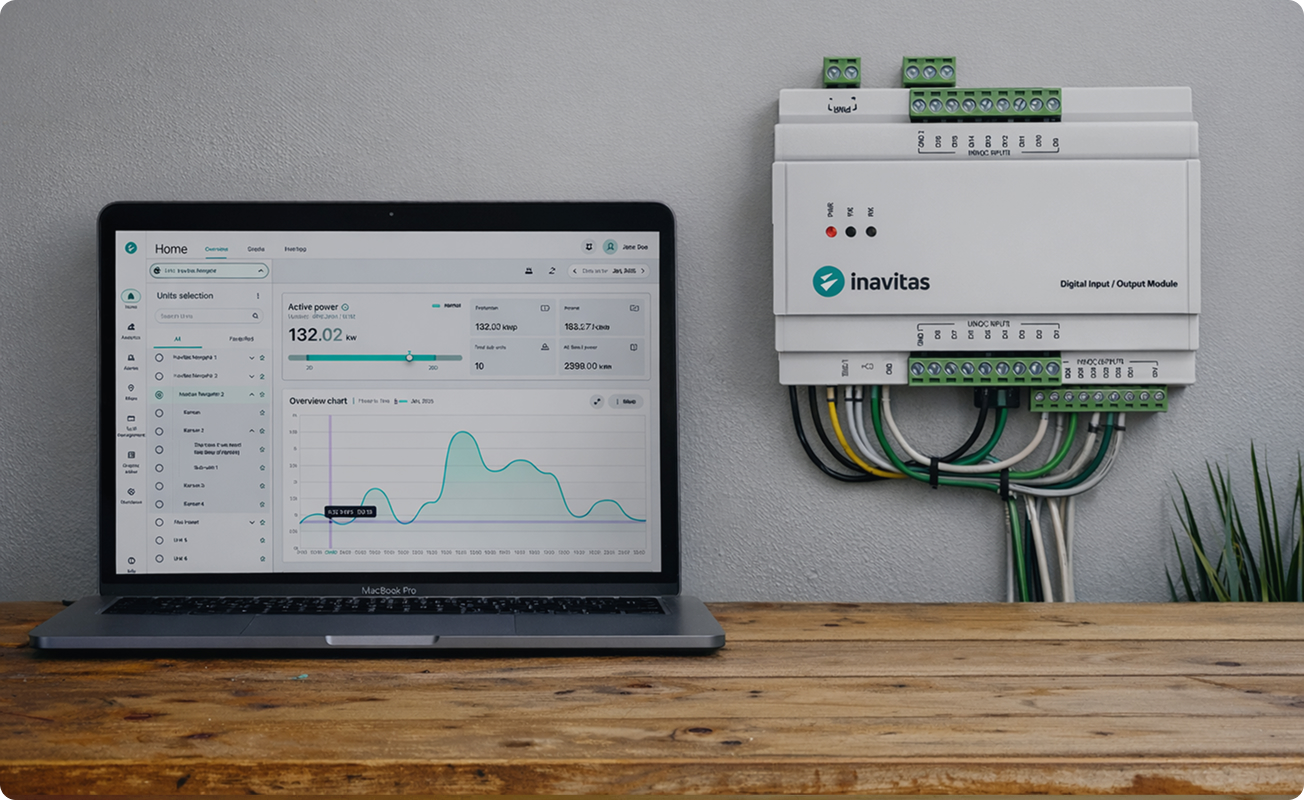
IoT and AI for real-time insight
From field IoT devices to Presify’s analytics and AI algorithms, Inavitas connects data across assets, sites, and portfolios so operators see issues early and act in time.

Proven technology and R&D depth
50+ R&D projects, 100+ engineers, and a growing portfolio of patents. Our teams turn grid and plant expertise into products that are battle-tested in the field.
Certified quality and global standards
CMMI-assessed development, grid-code–compliant controllers, and secure architectures give utilities, IPPs, and businesses confidence to scale with lower risk.

Newsroom
Company updates, releases, and announcements, all in one place.


